
Local Policy Forum on On-Demand Services 2026
Obviously Sustainable partnered with Grab Indonesia to convene the first On-Demand Services (ODS) Local Policy Forum, bringing together 25 academics from across Indonesia to identify opportunities for evidence-based policy recommendations at the local level and to strengthen the on-demand services ecosystem.
Ayu Prabanto
5/13/20263 min read
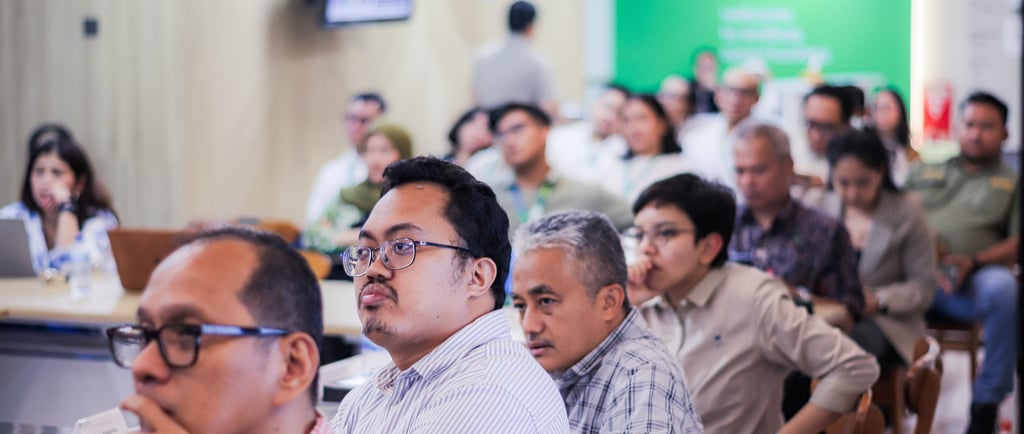
In 7-8 May 2026, Obviously Sustainable partnered with Grab Indonesia to convene the first On-Demand Services (ODS) Local Policy Forum, bringing together 25 academics from across the country to identify opportunities for evidence-based policy inputs at the local level and to strengthen the on-demand services ecosystem.
Indonesia's on-demand services industry operates within a patchwork of regional narratives and policies. Issues spanning business models, worker status, socio-cultural dynamics, and regional politics have created an uneven competitive landscape, where varying levels of policymaker understanding can produce unbalanced regulations that risk weakening demand, lowering driver-partner and MSME incomes, and ultimately threatening the sustainability of the wider ecosystem. The ODS Local Policy Forum 2026 was designed to meet this challenge by grounding policy conversations in research and regional context.
A Continued Academic and Policy Dialogue
The Forum is the latest milestone in a partnership that began in 2024. That year, Obviously Sustainable and Grab Indonesia held the inaugural Policy Forum on On-Demand Transportation Services in Jakarta, engaging 25 academics from across Indonesia. In 2025, the collaboration deepened through a research grants programme, with funding distributed to academic teams studying commission structures, the gig economy and skills development, and future mobility, producing several published op-eds. Building on this foundation, the 2026 ODS Local Policy Forum shifted the focus toward local-level advocacy, drawing on a growing network of academics now driving credible, evidence-based public narratives in support of the industry.
Voices From Eleven Cities
The Forum brought together 25 academics spanning nine fields of expertise from eleven cities across the archipelago, including Jabodetabek, Bandung, Yogyakarta, Bali, Surabaya, Medan, Palembang, Malang, Lampung, Samarinda, and Makassar. This breadth of representation allowed the discussions to reflect the genuine diversity of conditions shaping on-demand services in different parts of Indonesia, from dense metropolitan markets to regions where local and traditional authorities hold significant sway.
Shared Patterns Across the Regions
Through a series of focus group discussions, common patterns emerged across every regional cluster. Participants pointed to recurring misalignment between central and local regulations, political pressure that too often outweighs evidence, gaps in institutional dialogue channels, communication deficits in how research reaches the public, and policies that lack a strong intellectual foundation. In response, academics surfaced practical advocacy directions: regulatory harmonisation through judicial review and joint implementation guidelines, evidence-based policy advocacy through independent briefs and impact studies, institutional dialogue channels such as multi-stakeholder forums, strategic communication that packages research for the public, and cross-university academic coalitions to strengthen the evidence base.
Distinct Regional Realities
Beyond the shared themes, each cluster surfaced its own priorities. In Jabodetabek, the densest market, discussion centred on formally integrating on-demand services into the multimodal public transport ecosystem, alongside supporting infrastructure at transit hubs and the sector's role in low-emission targets. In West Java and South Sumatera, conversation focused on the commission cap and the need for regulatory certainty and gradual policy transition aligned with industry maturity. In Central Java, DIY, North Sumatera, and Batam, academics examined the political dimension of policy, where decisions are too often reactive to demonstrations rather than grounded in evidence. In the eastern clusters spanning East Java, Kalimantan, Bali-Nusra, Sulawesi, and beyond, themes included central and local tariff tensions, cooperative mandates that partners resist, and the strong authority of traditional villages over who may operate.
A Roadmap Toward an Independent Institute
The Forum also looked ahead. Under a shared roadmap from 2024 to 2030, the partnership envisions an ODS Working Group that is intellectually backed, academically led, and operationally supported, ultimately evolving into an independent academic institute that serves as Indonesia's premier research and policy voice on on-demand transport services. To sustain momentum, the Working Group commits to a structured output calendar of op-eds, policy briefs, working papers, and strategic research, ensuring a steady flow of credible, evidence-based contributions to national and regional policy debates.
A Foundation for Evidence-Based Policy
The first ODS Local Policy Forum marks an important step in turning a trusted academic network into a durable platform for evidence-based policy recommendations. By giving researchers the space to deep-dive into local issues and translate them into actionable recommendations, the Forum strengthened both the quality of dialogue and the foundations for continued collaboration.
Connect
Let's collaborate and join us in advancing people-centred twin transition
MAILING ADDRESS
DROP YOUR MESSAGE
admin@o-sustainable.com
© Obviously Sustainable. 2025.
All rights reserved.
Obviously Sustainable
Karya Positif Berkelanjutan
SMESCO Indonesia Floor 6.
Gatot Subroto Rd. No. 94.
South Jakarta, Indonesia 12780.