
Indonesia Connectivity Forum 2026
Rezha Bayu Oktavian Arief
6/5/20263 min read
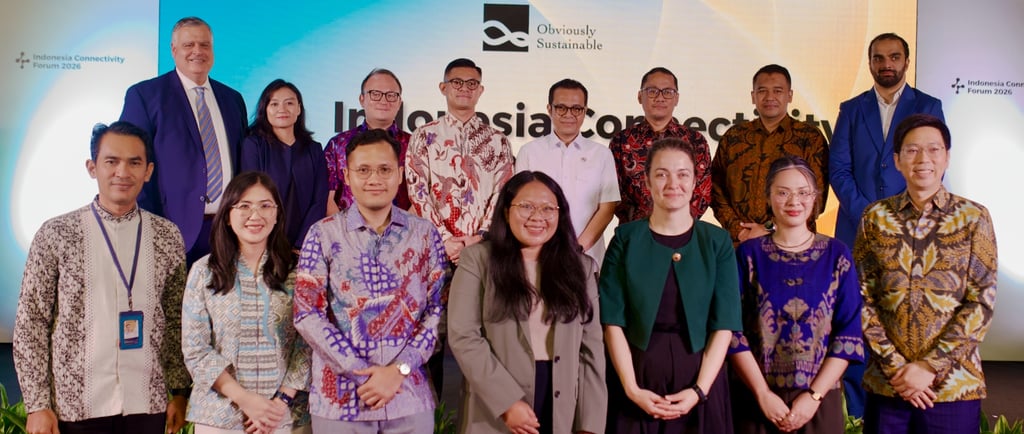
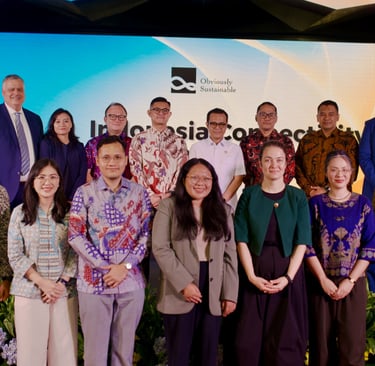
On 3 June 2026, Obviously Sustainable hosted and led the Indonesia Connectivity Forum 2026 in Jakarta, convening leaders from government, industry, civil society, and academia to advance a shared agenda for inclusive digital access across Indonesia's 3T (Left Behind, Foremost, Outermost) regions.
Closing the Digital Divide in the 3T Regions
Indonesia continues to make important progress on its national digital transformation, expanding infrastructure and broadening connectivity across the archipelago under the leadership of the Ministry of Communication and Digital Affairs. Yet reliable and affordable connectivity remains uneven in the country's 3T regions (terdepan, terluar, tertinggal), where geographic complexity, dispersed populations, and the high cost of deployment continue to challenge conventional broadband expansion. Against this backdrop, the Indonesia Connectivity Forum 2026 served as a neutral, multi-stakeholder platform to examine how Non-Geostationary Satellite Orbit (NGSO) systems, including Low Earth Orbit (LEO) satellites, can complement Indonesia's connectivity mix and help close the digital divide.
A Shared Agenda for Equitable, Resilient Connectivity
Opening the forum, Vice Minister of Communication and Digital Affairs of Indonesia, Nezar Patria, endorsed the forum and delivered a keynote underscoring that terrestrial infrastructure alone cannot close the remaining digital divide. He positioned NGSO technology, particularly LEO satellites, as a breakthrough that improves availability in geographically challenging areas, enhances affordability by lowering deployment costs in remote regions, and delivers high-quality, low-latency access for critical services such as healthcare, disaster response, and public service delivery. The Vice Minister called for strengthened cross-sector collaboration through innovative financing and dynamic public-private partnerships, and thanked Obviously Sustainable for convening the forum, framing it not as a debate over which technology to deploy but as a shared responsibility to ensure any breakthrough is truly applicable and viable for every Indonesian.
Connectivity as Both a Demand and Supply Challenge
Two expert panels carried the discussion forward, anchored in independent research from Access Partnership and the Lowy Institute while keeping the conversation centred on inclusive, equitable access. The first panel, Complementing Indonesia's Connectivity Mix to Expand Digital Access, brought together voices from the Ministry of Communication and Digital, J-PAL Southeast Asia, The World Bank, and Access Partnership. Panellists noted that Indonesia's connectivity gap is as much about demand as supply: of the roughly 150 million people across ASEAN who lack reliable internet, an estimated 50 to 60 million are in Indonesia. Closing the gap therefore means addressing affordability, digital literacy, and relevant local use cases, not towers and spectrum alone. NGSO and LEO, the panel agreed, are best understood as a managed opportunity that delivers the most value when integrated alongside terrestrial networks under one connectivity umbrella, supported by regulatory reform including proportionate licensing and spectrum interoperability.
Turning Connectivity into Public Value
The second panel, Opportunities through Connectivity to Accelerate 3T Region Development, featured speakers from INDEF, the Ministry of Tourism, the National Agency for Disaster Management, ICT Watch, and the satellite connectivity industry. Discussion framed connectivity in 3T regions as an enabler of livelihoods and resilience rather than an end in itself, opening isolated areas to markets, expanding MSME and women's economic participation, and supporting community-based tourism that channels income to local residents. Its value in disaster response was made vivid by the example of floods and landslides that damaged 11,000 BTS in Sumatra, where LEO offers rapid, portable communication when terrestrial networks fail. Panellists stressed that the central challenge is no longer access but who actually benefits, calling for a "no size fits all" approach that positions 3T communities as active participants. Affordability and sustainability emerged as the decisive constraints, with providers working to bring LEO hardware below USD 400 and to design satellites with extended lifespans of around seven years to address space-debris concerns.
A Convening of 87 Voices Across 42 Institutions
The forum was attended by 87 participants from 42 institutions, spanning government ministries, civil society and associations, research institutions, industry, multilateral organisations, and diplomatic missions. This breadth reflected the forum's role as a rare, neutral space where institutions could exchange views directly and align around a common goal.
A Foundation for Indonesia's Connected Future
The Indonesia Connectivity Forum 2026 marks the beginning of a sustained collaborative journey. From regulatory enablers and financing models to disaster resilience and inclusive economic growth, the discussions underscored a shared commitment to building connectivity that is equitable, resilient, and future-ready. With strong interest from KOMDIGI in continuing the dialogue, the forum holds a first-mover position as a lasting platform for the 3T and meaningful-access agenda in Indonesia.
Obviously Sustainable is proud to support this momentum and looks forward to continuing the work with Indonesia's stakeholders to ensure that every citizen, in every region, can share in the benefits of a connected future.
Connect
Let's collaborate and join us in advancing people-centred twin transition
MAILING ADDRESS
DROP YOUR MESSAGE
admin@o-sustainable.com
© Obviously Sustainable. 2025.
All rights reserved.
Obviously Sustainable
Karya Positif Berkelanjutan
SMESCO Indonesia Floor 6.
Gatot Subroto Rd. No. 94.
South Jakarta, Indonesia 12780.