
How Southeast Asia’s Twin Transitions Are Shaping a More Inclusive Future
Obviously Sustainable and the Indonesia Ocean Justice Initiative (IOJI) hosted a vibrant conversation on one of the most defining challenges of our time: how Southeast Asia can successfully navigate the green and digital transitions while ensuring that no community is left behind.
Rezha Bayu Oktavian Arief
7/7/20253 min read
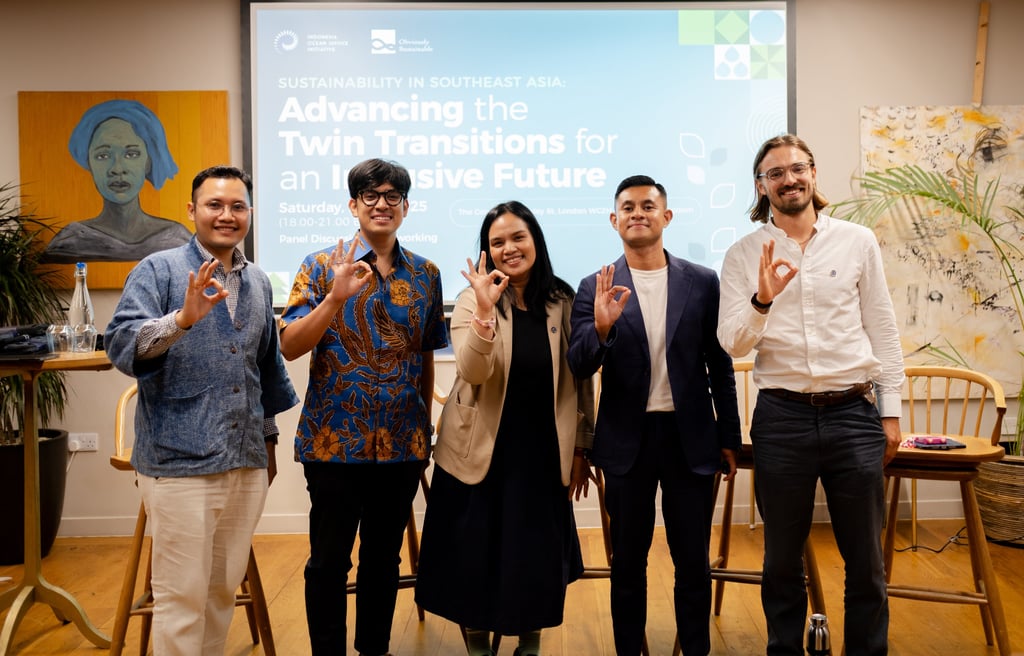
On 5 July 2025, at The Conduit in London, Obviously Sustainable and the Indonesia Ocean Justice Initiative (IOJI) hosted a vibrant conversation on one of the most defining challenges of our time: how Southeast Asia can successfully navigate the green and digital transitions while ensuring that no community is left behind.
Bringing together practitioners from the climate, energy, and ocean governance arenas, the event—“Sustainability in Southeast Asia: Advancing the Twin Transitions for an Inclusive Future”—offered a rare cross-sector lens on what it takes to build transformations that are people-centred, equitable, and resilient.
Why Southeast Asia’s Transitions Matter
Home to over 680 million people and some of the world’s most climate-exposed geographies, Southeast Asia sits at the intersection of huge opportunity and intense vulnerability. The region is digitising rapidly, yet still grappling with infrastructure gaps. It is rich in natural resources, yet deeply affected by environmental degradation.
Throughout the discussion, one theme was unmistakable: the green and digital transitions cannot be treated separately. They are deeply intertwined—and their success depends on how effectively governments, industry, civil society, and communities collaborate.
Climate Action Must Reflect Local Realities
Opening the panel, Agra Suryadwipa, Manager for Energy & Climate at Systemiq Ltd, reminded the audience that climate ambition must be grounded in Indonesia’s socioeconomic context. Tackling poverty, energy access, and uneven development is inseparable from advancing sustainability.
“It is meaningless to talk about climate action without addressing poverty,” he noted, pointing to the growing awareness of climate risks across Indonesia.
Protecting the Ocean, Protecting Communities
From an ocean governance perspective, James Morris, Climate Policy Manager at the Blue Marine Foundation, emphasised the ocean’s vital, but increasingly strained, role in absorbing heat and supporting livelihoods.
“The ocean is Earth’s life support system,” he said, warning that without stronger protection for coral reefs and coastal ecosystems, the ocean’s ability to buffer climate shocks will continue to weaken.
His intervention underscored why coastal communities must be central to climate strategies—not an afterthought.
Digital Tools as Engines of Inclusion
Shifting to the digital dimension of the transition, Rezha Bayu Oktavian Arief, Co-founder and CEO of Obviously Sustainable, highlighted how technological solutions can unlock both environmental and social benefits—if designed with communities in mind.
“We cannot talk about sustainability without centring people,” he said. “Digital solutions can reduce global emissions by up to 20% by 2050, but in ASEAN, we must first double our renewable energy capacity by 2030.”
He argued that the region’s digital acceleration is an opportunity to empower local innovators, strengthen decision-making, and build resilience from the ground up.
Putting Equity and Human Rights at the Core
Representing a governance and rights-based perspective, Fadilla Octaviani, Co-founder and Senior Advisor at IOJI, stressed that sustainable development cannot come at the expense of those who rely most directly on natural resources.
“Equity and human rights must be embedded as core principles in blue economy policies,” she said, urging policymakers to meaningfully involve small-scale fishers, women, and other marginalised groups in shaping the future of ocean governance.
A Call for Collaboration, Innovation, and Accountability
Taken together, the insights shared throughout the event made one thing clear: Southeast Asia’s future depends on its ability to integrate environmental sustainability with digital progress, while ensuring these transitions deliver real benefits to communities.
The discussion at The Conduit served as more than a conversation—it was a blueprint for how cross-sector collaboration can drive transformative change. By bridging perspectives from policy, technology, conservation, and grassroots advocacy, the event set a new benchmark for how stakeholders can co-design solutions that are ambitious yet grounded, innovative yet inclusive.
As Southeast Asia continues to navigate its twin transitions, dialogues like this will be crucial in shaping policies and partnerships that advance not just technological progress, but also justice, resilience, and dignity for all.
Connect
Let's collaborate and join us in advancing people-centred twin transition
MAILING ADDRESS
DROP YOUR MESSAGE
admin@o-sustainable.com
© Obviously Sustainable. 2025.
All rights reserved.
Obviously Sustainable
Karya Positif Berkelanjutan
SMESCO Indonesia Floor 6.
Gatot Subroto Rd. No. 94.
South Jakarta, Indonesia 12780.