
Corporate Sustainability and Environmental Rights in Asia Conference 2026
Obviously Sustainable took part in the plenary panel "Is ESG Enough? Transparency, Risk, and the Shift to Mandatory Due Diligence" at the Corporate Sustainability and Environmental Rights in Asia Conference, held at the AICB Centre of Excellence in Kuala Lumpur. Co-Founder and CEO Rezha Bayu Oktavian Arief joined regulators, investors, and business leaders to ask a pointed question: when companies report on risks, are they actually mitigating them?
Dio Tobing
4/13/20263 min read

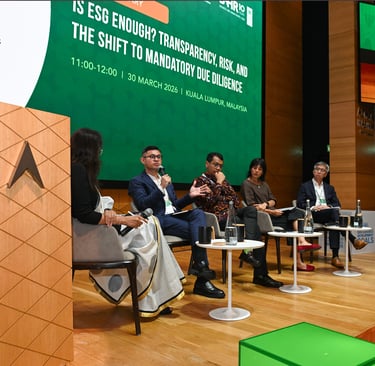
On 30 March 2026, Obviously Sustainable took part in the plenary panel "Is ESG Enough? Transparency, Risk, and the Shift to Mandatory Due Diligence" at the Corporate Sustainability and Environmental Rights in Asia Conference, held at the AICB Centre of Excellence in Kuala Lumpur. Co-Founder and CEO Rezha Bayu Oktavian Arief joined regulators, investors, and business leaders to ask a pointed question: when companies report on risks, are they actually mitigating them?
As ESG disclosure matures across Asia, a growing concern is that transparency alone may not be enough to protect workers, communities, and the environment. The session examined the limits of disclosure frameworks and the regional shift toward mandatory human rights and environmental due diligence, exploring how companies can move from simply reporting impacts to systematically identifying, preventing, and addressing them across their operations and supply chains.
A High-Level Conversation Across Sectors
Moderated by Dr. Harpreet Kaur of UNDP Asia-Pacific, the panel brought together a deliberately cross-sector group: Hong Lee of Amfori on global audit standards, Martina Chow of the Asia Investor Group on Climate Change on the investor lens, Faroze Nadar of the UN Global Compact Network Malaysia on the regulatory shift, and Rezha Bayu of Obviously Sustainable on the intersection of technology and people. Structured around the difference between the "standard" and "action," the discussion probed whether better reporting genuinely translates into better lives on the ground, including the risk that strong climate commitments can mask limited visibility into deeper-tier labour practices.
Digital Versus Technology: Bridging the Transparency Gap
Asked how digital tools can help close the transparency gap in complex markets like Indonesia, Rezha drew a useful distinction between digital and technology. Digital, he explained, covers the data, software, platforms, and tools that help companies collect, process, and communicate information, improving traceability and the credibility of impact reporting. Technology is broader, encompassing innovations that can themselves create environmental and social value. Drawing on Obviously Sustainable's work with one of Southeast Asia's largest travel technology companies, as well as with cloud and mobility actors, he argued that digital makes impact more visible and manageable, while technology can help create the impact itself, whether through more efficient infrastructure, lower-emission systems, or new income opportunities. The key, he stressed, is to use both not just for reporting but for better accountability and better outcomes for communities.
A People-Centred View of Due Diligence
On whether mandatory due diligence truly helps workers, Rezha offered a candid, context-driven perspective. He noted that frameworks modelled on developed economies can create a mismatch with local realities, pointing to Indonesia's agricultural sector, where many farmers do not own land and intermediaries sit between smallholders and large companies. A people-centred approach, he argued, means focusing on those who are most often unseen, and advocating for regulations that place due diligence at the core of primary businesses' operations, supported by both fiscal incentives such as tax reductions and ESG funds and non-fiscal incentives such as social protection, reskilling, and career mobility. He cautioned that mandatory requirements, while crucial for large corporations' competitiveness, can be costly for the small businesses that make up the vast majority of Southeast Asia's economy, and that current approaches risk leaning too heavily on disclosure as a compliance exercise.
From Red Flags to Resilience
Addressing how companies should respond when a report surfaces a risk without a clear remedy, Rezha pointed to stakeholder engagement as the essential first operational step: recognising the red flag and engaging directly with those most affected, citing the example of nickel mining workers in Southeast Sulawesi. He also highlighted Obviously Sustainable's collaboration with Indonesia's Ministry of Communication and Digital Affairs to assess the sustainability readiness of early-stage startups through a developing Sustainability Readiness Index, reflecting a core belief that sustainability is best embedded as a mindset as early as possible.
ESG as the Map, Action as the Compass
The session closed with a fitting metaphor: if ESG is the map, what is the compass that ensures companies actually reach a sustainable outcome? For Obviously Sustainable, the answer lies in moving beyond disclosure toward genuine accountability and measurable impact for people and communities.
Connect
Let's collaborate and join us in advancing people-centred twin transition
MAILING ADDRESS
DROP YOUR MESSAGE
admin@o-sustainable.com
© Obviously Sustainable. 2025.
All rights reserved.
Obviously Sustainable
Karya Positif Berkelanjutan
SMESCO Indonesia Floor 6.
Gatot Subroto Rd. No. 94.
South Jakarta, Indonesia 12780.